
gilles AUDOUX
44380 PORNICHET
France
The seller is responsible for this advert and its content.
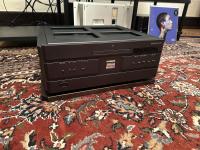
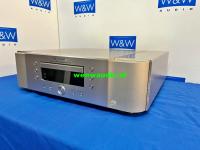
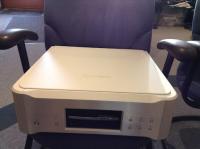
Playback Designs MPS8 CD/SACD DAC PREAMPLI
Product information
- Product category
- SACD Player
- Manufacturer
- Playback Designs
- Function
- flawless
- Age
- 3 years 3 months According to invoice
- Usage state
- Other
- Appearance
- as good as new
- Accessories
- complete with original box
- Color
- ANTHRACITE
- Original price
- 32,990.00 €
- Price
- 15,990.00 €
- More information
- http://www.playbackdesigns.com/
- Serial number
- 3256
Description
CD/SACD DAC playback designs dsd X4 avec fibre optique propriétaire que j'utilise entre mon streamer et le dac PB avec horloge usbx4 le son est magique naturel car plus de bruit numérique !
CD/SACD DAC playback designs dsd X4 with proprietary optical fiber that I use between my streamer and the PB dac with usbx4 clock the sound is magically natural because there is no more digital noise!
Digital inputs: USB (PCM up to 384 kHz, DSD up to 11.2 MHz), AES (PCM up to 192 kHz, DSD over DoP), 2 x S/ PDIF (coaxial PCM up to 192 kHz, DSD over DoP or TOSLINK PCM up to 96 kHz), PLINK optical link (PCM up to 384 kHz, DSD up to 11.2 MHz) | Digital outputs: PLINK optical link, AES (PCM up to 192 kHz, DSD over DoP) | Analog outputs: balanced (XLR), unbalanced (RCA) | Dimensions (W/H/D): 46/13/43 cm | Weight: 18.2 kg
I also wondered how the MPS-8 would behave when faced with files fed by USB. I primarily stuck to FLAC files with different bit rates as the availability of DSD files in the relevant download stores is still pretty limited. Unlike with the upsampling of an (SA)CD, the files being played here would essentially get upsampled to 352 kilohertz. In theory, the USB input should be superior in terms of sound quality. Bert Gerlach is confident about the results produced by the in-house-developed PDFAS (Playback Designs Frequency Arrival System), which is designed to reliably eliminate jitter. I wasn’t, however, able to make out any real difference compared with CD playback using the internal drive. I could hear the already familiar effortlessness and perfect transparency when I played Rolf Kühn’s new album Yellow + Blue. Mean-spirited high-end fans sometimes like to focus on trivial matters relating to the music in order to draw conclusions about the quality of their system’s playback. Some developers capitalize on that by deliberately placing a strong focus on chiff or the movement of an instrument’s keys; this ultimately results in audiophile razzle-dazzle taking over. Of course, I could also make out Kühn’s chiff and heard the clearly recorded sounds made by his clarinet’s keys, but that never sounded excessively prominent and was embedded in the general flow of the music. I also got the impression the upsampling resulted not in a higher resolution but in more natural playback.
On the advice of the sales team, I also used the MPS-8’s preamplifier section. Alternating between connecting the device to my power amplifier and my active studio monitors, I was amazed at the immediacy that could be achieved like this. I quickly realized there was absolutely no need for an additional preamplifier unless you wanted to achieve a specific sound or connect additional devices, that is. Slightly more direct and a tad more dynamic: The music seemed a bit different to me, which I personally liked even more than before with my own preamplifier. Using the remote control, the volume was easy to adjust at the tiniest of increments. As a result, anyone who prefers a purely digital setup should definitely consider the minimal configuration of MPS-8 plus active loudspeakers; in view of the player’s attractive design, this is a tantalizingly minimalist option in terms of style, too. Before I wrap things up here, I should mention the additional streaming module available for €3,000, which I didn’t have for this report. With it, you can also directly integrate the usual services and portals. Since I’m a fan of direct computer connection, I wasn’t all that bothered about not having it. But regardless of how you operate the Playback Designs MPS-8, you’ll definitely find this really is as good as digital gets. The name “Dream Player,” is no exaggeration. It’s a validation
CD/SACD DAC playback designs dsd X4 with proprietary optical fiber that I use between my streamer and the PB dac with usbx4 clock the sound is magically natural because there is no more digital noise!
Digital inputs: USB (PCM up to 384 kHz, DSD up to 11.2 MHz), AES (PCM up to 192 kHz, DSD over DoP), 2 x S/ PDIF (coaxial PCM up to 192 kHz, DSD over DoP or TOSLINK PCM up to 96 kHz), PLINK optical link (PCM up to 384 kHz, DSD up to 11.2 MHz) | Digital outputs: PLINK optical link, AES (PCM up to 192 kHz, DSD over DoP) | Analog outputs: balanced (XLR), unbalanced (RCA) | Dimensions (W/H/D): 46/13/43 cm | Weight: 18.2 kg
I also wondered how the MPS-8 would behave when faced with files fed by USB. I primarily stuck to FLAC files with different bit rates as the availability of DSD files in the relevant download stores is still pretty limited. Unlike with the upsampling of an (SA)CD, the files being played here would essentially get upsampled to 352 kilohertz. In theory, the USB input should be superior in terms of sound quality. Bert Gerlach is confident about the results produced by the in-house-developed PDFAS (Playback Designs Frequency Arrival System), which is designed to reliably eliminate jitter. I wasn’t, however, able to make out any real difference compared with CD playback using the internal drive. I could hear the already familiar effortlessness and perfect transparency when I played Rolf Kühn’s new album Yellow + Blue. Mean-spirited high-end fans sometimes like to focus on trivial matters relating to the music in order to draw conclusions about the quality of their system’s playback. Some developers capitalize on that by deliberately placing a strong focus on chiff or the movement of an instrument’s keys; this ultimately results in audiophile razzle-dazzle taking over. Of course, I could also make out Kühn’s chiff and heard the clearly recorded sounds made by his clarinet’s keys, but that never sounded excessively prominent and was embedded in the general flow of the music. I also got the impression the upsampling resulted not in a higher resolution but in more natural playback.
On the advice of the sales team, I also used the MPS-8’s preamplifier section. Alternating between connecting the device to my power amplifier and my active studio monitors, I was amazed at the immediacy that could be achieved like this. I quickly realized there was absolutely no need for an additional preamplifier unless you wanted to achieve a specific sound or connect additional devices, that is. Slightly more direct and a tad more dynamic: The music seemed a bit different to me, which I personally liked even more than before with my own preamplifier. Using the remote control, the volume was easy to adjust at the tiniest of increments. As a result, anyone who prefers a purely digital setup should definitely consider the minimal configuration of MPS-8 plus active loudspeakers; in view of the player’s attractive design, this is a tantalizingly minimalist option in terms of style, too. Before I wrap things up here, I should mention the additional streaming module available for €3,000, which I didn’t have for this report. With it, you can also directly integrate the usual services and portals. Since I’m a fan of direct computer connection, I wasn’t all that bothered about not having it. But regardless of how you operate the Playback Designs MPS-8, you’ll definitely find this really is as good as digital gets. The name “Dream Player,” is no exaggeration. It’s a validation
Seller:
- Shipping from France (44380)
- Purchaser pays shipping costs
- EU wide shipping
Payment methods
- Bank transfer
- PayPal
- Prepayment (bank transfer)
Advert ID
5965866768
Advert time period- Start:
- 23.01.2026 - 10:05
- End:
- 24.03.2026 - 10:05
92 times in 2 day(s)