


The seller is responsible for this advert and its content.
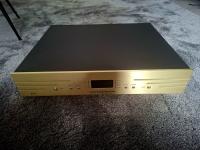
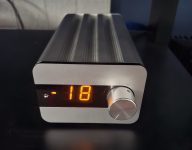
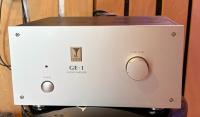
Swissonor.ch Swissonor PPP-PP HM7 phono preamp with Hashimoto Transformers
Product information


- Product category
- Phono Amplifier
- Manufacturer
- Swissonor.ch
- Function
- flawless
- Age
- 8 months According to invoice
- Usage state
- second-hand
- Appearance
- as good as new
- Accessories
- complete with original box
- Color
- Black
- Original price
- 3,950.00 €
- Price
- 2,900.00 €
Description
Hello,
I put on sale my Swissonor PPP-PP HM7 phono stage which suits high-end MC cartridges, with its 2 big japanese Hashimoto transformers, it is the best preamp I have ever had and I owned many from 10 k€ to 30 k€ range. It is in absolute mint condition like new and comes with its power supply and rca cables (so no need to use extra and costly cables).
The unit employs Hashimoto transformers which can be configured via jumpers for either low-impedance (approx. 3 ohms) or medium-impedance (approx. 12 ohms) cartridges. By feeding directly into the phono circuitry, these transformers ensure the highest possible sound quality.
The soundstage is hugen the sound is powerful and dynamic but with a lof of finesse and details.
Gain :
23 dB (12 ohms) or 29 dB (3 ohms)
- bandwidth :
HM7 : 5 Hz a 100 kHz +/- 1dB
The finest moving-coil (MC) cartridges deserve the best possible pre-amplification—an aspect all too often overlooked. A low-impedance cartridge produces a signal with extremely low voltage but high current, which makes the use of step-up transformers (SUTs) ahead of the phono stage highly advantageous. This is because a transformer utilizes the entire energy generated by the cartridge, whereas an electronic input (whether tube- or transistor-based) captures only the voltage—with more than 99% of the energy dissipated as heat within the input resistor.
The PPP-PP HM7 is designed to extract the absolute best from such a signal, while simultaneously eliminating ground loops that can cause hum.
It combines high-gain transformers with a dedicated phono preamplifier featuring a passive RIAA equalization network. This architecture preserves delicate micro-details, delivering a robust, universal signal ready for connection to a line-level preamplifier or an integrated amplifier.
The ground line from the turntable tonearm remains separate from the signal grounds throughout its entire path, connecting to the system ground only at the input of the line-level preamplifier.
The routing is optimized; the Swissonor #12.0 output cable—connected directly to the phono board without the use of plugs or connectors—ensures the same sound quality and freedom from hum as a balanced XLR connection.
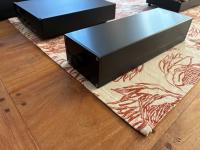
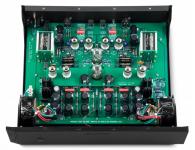
The mechanical construction, featuring thick aluminum plates decoupled across three levels and mounted on a heavy gray cast-iron base, is unique in the global market.
The integrated phono board utilizes an active-passive-active configuration. Gain at both stages can be adjusted via jumpers to match the cartridge's output voltage and the requirements of either an active or passive line-level preamplifier. The passive RIAA equalization network consists of a parallel array of polypropylene (PP) film capacitors—using both tin and aluminum foil—with a 1% tolerance (!)
I reamin at your disposal if you have any questions.
An external 24 VDC power supply, combined with an internal LCR-based conditioning circuit that converts it to +/- 12V, provides an output voltage sufficient to drive passive preamplifiers, integrated amplifiers, or power amplifiers (equipped with input volume controls) directly, without the need for an intermediate gain stage.
Seller:
- Shipping from France (83470)
- Purchaser pays shipping costs
- Worldwide shipping
Payment methods
- Bank transfer
Advert ID
3106736275
Advert time period- Start:
- 29.11.2026 - 10:44
- End:
- 28.01.2027 - 10:44
5 times in 16 minute(s)